Emergency kit
What to have ready so your household can look after itself for at least 72 hours without power or tap water.
What goes in the kit
Be ready to get by without power or tap water for at least 72 hours, the Government of Canada says, and keep the kit in one bag that everyone can find (Get Prepared).
Water and food
2 litres per person per day for drinking, plus 2 more for cooking and washing, for at least three days (Health Canada), and food that won’t spoil, with a manual can opener.
Light, a radio and charging
Flashlights or battery lanterns instead of candles, a crank or battery radio for when the internet is down, and a battery pack that can charge your phones several times (Government of Canada).
Alarms and medicines
A CO alarm with battery backup outside the bedrooms (Health Canada), spare batteries, your medications, and a plan for any medical device that needs power.
A way to get alerts
Weatheradio Canada has shut down (ECCC). Install the WeatherCAN app and rely on Alert Ready for emergency alerts; a radio keeps local news coming when your phone is flat.
Safety: Never use a generator, barbecue, camp stove or portable burner inside a home, garage, basement or shed, even with the doors open. If a CO alarm sounds, get everyone out into fresh air, then call 9-1-1 (Get Prepared).
What helps
The kit pieces we compare: a radio, a lantern and a power bank, a CO alarm, and N95 masks for smoke.
Radios
Midland ER310 Emergency Crank Weather Radio
AM/FM, NOAA alerts, crank and solar in one go-bag radio
Lights and power banks
Goal Zero Lighthouse 600 Lantern & USB Power Hub
600 lm lantern with USB out and a hand crank for long outages
Anker Power Bank
90 Wh with two built-in USB-C cables and 165 W total
CO alarms
First Alert CO3-P01 Plug-In Carbon Monoxide Alarm with Battery Backup
Plugs in, keeps watching on a 9 V backup when the power fails
Smoke masks
Moldex 2200N95 N95 Particulate Respirator
NIOSH N95 (TC-84A-0327) with a foam nose seal and no metal strip
3M 8210 N95 Particulate Respirator
The best-known NIOSH N95, approval TC-84A-0007
Our guide
Explainer
Weatheradio Canada has shut down: how to get weather alerts now
Weatheradio and Hello Weather ended in March 2026. Here is what replaces them in Canada, and what a radio is still good for.
Questions about emergency kits
How long should an emergency kit last?
At least 72 hours. The Government of Canada says to be ready to get by without power or tap water for that long, and to include a flashlight, a radio and chargers for your phones. Keep it in one bag that everyone can find.
Are candles OK in a power outage?
Use flashlights or lanterns instead. The Government of Canada says flashlights lower the fire risk compared with candles, and the US CPSC gives the same advice.
Do I need a radio in my kit?
Yes: the Government of Canada lists one, and a crank or battery AM/FM radio brings local news when the power and internet are down. In the US, a NOAA alert model also wakes you for warnings in your county (NWS). In Canada, alerts come through Alert Ready and the WeatherCAN app.
How big a power bank do I need?
Enough for your phones for the outage you plan for. The Government of Canada suggests a battery pack that can charge critical devices several times. For longer outages, a power station charges phones, lights and a CPAP for days.
Where should CO alarms go?
Health Canada says the most important place is the hallway outside sleeping areas, with a battery backup, and a Canadian certification mark on the alarm and box. The US CPSC adds one on every level, tested monthly.
Comes with

Power outages
Keeping the furnace, fridge and sump pump running when the grid goes down, and connecting backup power safely.

Ice storms
Freezing rain, ice on lines, roofs and trees, and the long outages that follow.
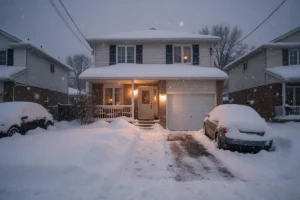
Snowstorms
Clearing heavy snow from the drive and the roof, and stopping ice dams.
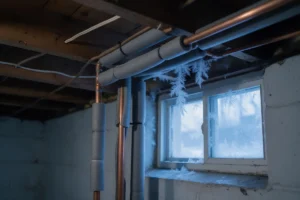
Cold snaps
Safe heat, pipes that stay unfrozen and an alert before the house gets cold.

Flooding
Keeping water out of the basement, a pump running when it rises, and what to do first if it gets in.
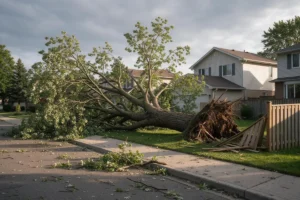
Wind and storms
Surge protection, backup power and help with fallen trees after high wind.

Heat waves
Keeping one room cool through a run of very hot days.
Wildfire smoke
Clean air indoors when smoke drifts in, and masks for going out.