Keep the house closed up and the heat in, turn the thermostat down and the appliances off, and heat it only in ways that are safe indoors. If the outage looks long and the house is getting cold, shut off the water main and drain the plumbing, as the Government of Canada advises. Heat cable and freeze alerts help only while something keeps them powered.
- Time
- Minutes to shut off the main; allow longer to drain the whole house and the water heater, so start in daylight
- Difficulty
- Easy to moderate · a plumber for any pipe that has burst or won't thaw
- Cost
- Nothing to drain the pipes; pipe insulation, plumbing antifreeze and a short heat cable are low-cost; backup power is the big spend
Safety: never run a generator, barbecue, camp stove or propane heater indoors, in the garage or in a shed. Health Canada says to keep a fuel-powered generator at least 6 m (20 ft) from any building, and never plug one into a wall outlet. Use flashlights, not candles. Never thaw a pipe with a torch or any open flame. Don’t go into a flooded basement unless you are sure the power to it is off. If a CO alarm sounds, get out, call 9-1-1 and stay out (Health Canada).
The cold snaps page adds safe space heat, freeze alerts and CO alarms, and lists heating contractors and plumbers.
Why an outage freezes pipes
In a winter outage the heat usually goes with the lights: the federal winter-outage brochure’s advice on standby heat is to choose a unit that does not depend on an electric motor, fan or other electrical device. The Government of Canada lists frozen water pipes among the risks of an extended outage and asks every household to be ready to look after itself for at least 72 hours (Get Prepared, power outages).
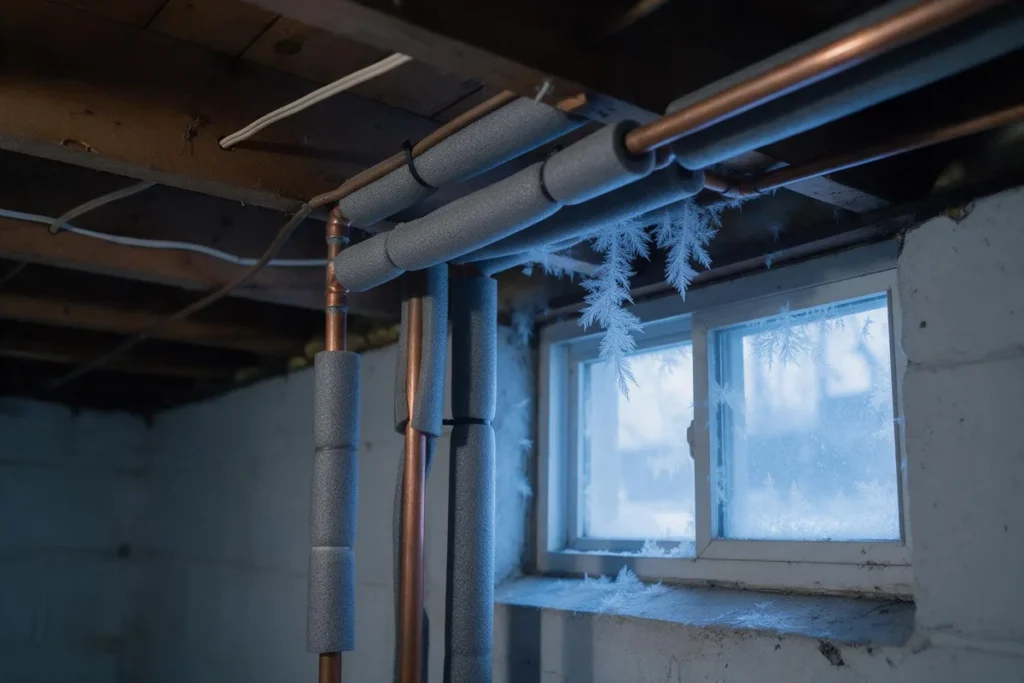
Pipes freeze first where they are coldest: along outside walls, where the water service enters through the foundation, and in basements, crawl spaces, garages and attics (City of Toronto, frozen pipes, updated October 2026). Water expands as it freezes, which is what splits a pipe.
What you’ll need
- To know where your main water shut-off is, and that it turns.
- A garden hose long enough to reach from the water heater’s drain valve to a floor drain.
- Plumbing antifreeze (glycol) for the toilet bowls and the sink and tub traps.
- Blankets or insulation to wrap the main valve, the inlet pipe and the meter.
- Foam pipe covers for exposed pipes, and a flashlight with spare batteries.
- Optional: a pipe heat cable on the pipe that freezes first, a power source that can run it, and a battery freeze sensor. See roof and pipe heat cables.
Step 1: Prepare before the cold arrives
Most of the work happens in the fall, while the power is on:
- Find and test the main water shut-off valve.
- Seal drafts around windows, doors, vents, wiring and pipes, and fit foam covers on exposed pipes.
- Disconnect outdoor hoses, close the separate shut-off to outdoor taps if you have one, and open the outdoor taps to let them drain.
- Keep garage doors closed if pipes run through the garage, and ask a plumber for advice if indoor pipes freeze often.
Heat cable on the problem pipe. A short plug-in cable taped along the pipe that always freezes first, often where the water service comes in, keeps it above freezing while it has power. The Frost King HC6A is a 6 ft, 7 W per foot cable with a built-in thermostat that switches on below about 38 °F and off above about 45 °F. It is for water-filled metal or Schedule 40 plastic supply pipe from 3/8 in to 1 1/2 in, laid flat along the pipe: never wrapped, spiralled or overlapped, and never longer than the pipe. The self-regulating Raychem FrostGuard FG1-6P takes metal or plastic water pipe up to 2 1/2 in and, unlike the Frost King, can be spiralled evenly when it is longer than the pipe.
Fit either one as its maker says: tape it in place with the tape the instructions name, cover cable and pipe with non-flammable pipe insulation, never install it inside a wall, floor or ceiling, and plug it into a grounded, ground-fault protected outlet with no extension cord. The U.S. Consumer Product Safety Commission adds two checks for any heat tape: buy one labelled for your pipe’s size and length, and inspect it each fall, unplugged, replacing it at once if the insulation is cracked or charred (CPSC).
Freeze alerts. A warning while you are away or asleep gives you time to act. A smart thermostat such as the ecobee Smart Thermostat Enhanced can send a low-temperature alert, which ecobee says can warn you of a furnace problem before pipes freeze. It runs on the heating system’s 24 V supply and reaches you over Wi-Fi, so it goes quiet in a power cut, which is exactly when the house starts cooling. A battery sensor fills that gap. The YoLink Water Leak Sensor 4 runs on two AAA batteries, beeps four times at a freeze temperature you set in the app (and twice for water), and sends app alerts through the YoLink hub. Those app alerts need the hub and your internet connection to stay up; the beeps do not. More options: smart thermostats and water and freeze alarms.
Step 2: When the power goes out
- Check it is not just your house. If the neighbours have power, check your breakers. If the service wires to the house look damaged or are on the ground, stay well back and call your utility.
- Turn the heating thermostat down to minimum and switch off appliances and electronics, as the federal guidance advises, so nothing starts up all at once or is damaged by a surge when power returns. Leave one light switched on so you know when it does.
- Keep the heat in. The federal winter-outage brochure notes that a house with its doors and windows closed stays comfortable for several hours even in very cold weather. Keep doors shut and open the cabinet doors under sinks on outside walls so what warmth there is reaches the pipes.
- Heat only in safe ways. A natural gas fireplace can give warmth until power returns, but a gas stove should not be used for heat (Get Prepared). A wood fireplace is safe only if its flue was cleaned in the fall. Any fuel-burning standby heater should be certified (in Canada, by CSA or the Canadian Gas Association) and vented the way its maker specifies, the brochure says. Turn backup heat on before the house gets too cold.
- Power the heat cable if you can. A 6 ft pipe cable is a small load: the HC6A is rated at 7 W per foot, about 42 W in all. A portable power station can run it from inside the house, since battery units make no carbon monoxide (Get Prepared). Raychem’s instructions rule out extension cords for its cable, so plug the cable straight into the power station where its cord reaches. A fuel generator always stays outdoors, at least 6 m from the house; the safe way for it to feed a cable inside is through the house wiring. Connecting a generator to the house wiring needs a transfer switch or interlock installed by a licensed electrician; interlock vs transfer switch has the rules where you live. Our power station vs generator guide covers which suits you.
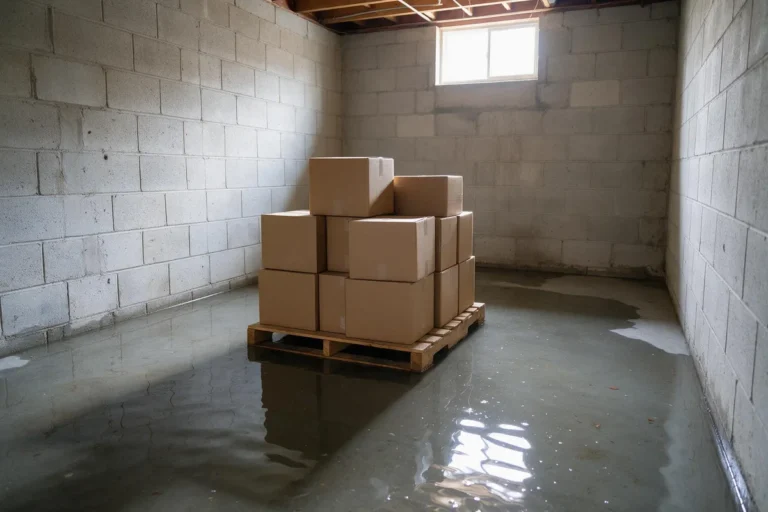
If you have a sump pump, it stops too. The federal brochure suggests clearing valuables off the basement floor in case groundwater rises; our backup sump pumps keep pumping on battery.
Step 3: Drain the plumbing if the outage will be long
When the power will be off for a long time, or you have to leave, the safe choice is to take the water out of the pipes before it can freeze. The Government of Canada says to learn how to shut off your water and to drain the plumbing, because pipes can freeze in winter outages. These steps follow the federal Winter Power Failures self-help brochure (Public Safety Canada, revised 2005, archived):
- Shut off the power to an electric water heater at its breaker.
- Turn off the water main where it enters the house, usually in the basement near the meter, and wrap the valve, the inlet pipe and the meter in blankets or insulation.
- Start at the top of the house. Open every tap, hot and cold, and flush each toilet several times.
- Open the drain valve in the basement to let the rest of the system empty.
- Drain the water heater through a hose run from its drain valve to the floor drain. If it is gas-fired, the pilot light has to be put out, and the brochure says to call your gas supplier to relight it afterwards.
- Unhook the washing machine hoses and drain them, and drain the dishwasher.
- Protect the traps. Small amounts of water left in horizontal pipes are not a worry, but pour a little glycol (plumbing antifreeze) into each toilet bowl and the sink and tub traps.
Leave the taps open once the system is drained. If anything here is beyond you, or the house has a well pump or a hot-water (boiler and radiator) heating system, which these steps don’t cover, ask a plumber.
Step 4: When the power comes back
- Give the grid a moment. Turn the heating thermostat up first, plug the fridge and freezer back in a few minutes later, and wait 10 to 15 minutes before reconnecting everything else (Get Prepared).
- If you drained the house, close the basement drain valve, reopen the main, and close the lowest taps first, letting air escape from the upper ones as the pipes fill.
- Fill the water heater before you turn its power on. Get Prepared and the federal brochure both say this.
- Look for leaks along exposed pipes, around the meter and under sinks as the water comes back, and shut the main again if you find one.
- Warm the house a little above normal for a few hours, as the brochure suggests, to dry everything out, and rinse the washer and dishwasher if needed.
Troubleshooting
- A tap gives no water, or a trickle: the pipe is probably frozen. Open the basement cold tap so water can flow as the ice melts, then warm the likely spot (outside walls, where the service enters) with a heating pad, hair dryer or warm towels, never left unattended. It can take one to six hours. Never use a torch, propane heater or open flame. Call a licensed plumber if you still have no water.
- A pipe has burst: turn off the main water supply straight away, switch off power to any wet area only if you can reach the breaker without standing in water, and call a plumber. If the basement has flooded, see what to do first when the basement floods.
- The heat cable’s plug light is off: check the outlet has power; Frost King says the ground-fault protection may have tripped. A flickering light means the cable may not be working and should not be used.
- The YoLink sensor beeps four times: that is its freeze warning. Two beeps mean it found water; fast red blinks mean the batteries are low (use alkaline or lithium AAAs, never rechargeable).
For everything else to sort before the next storm, see our ice storm and power outage checklist, and if the roof is icing up too, how to get rid of ice dams.
Frozen pipe questions
How long does it take for pipes to freeze without heat?
There is no single answer: it depends on how cold it is outside, how well the house is insulated and where the pipes run. The federal brochure says a closed-up house stays comfortable for several hours even in very cold weather, so you usually have time to decide. Pipes on outside walls and in unheated spaces freeze first.
Does leaving a tap dripping stop pipes freezing?
It helps in a heated house during a deep cold snap: City of Toronto guidance suggests a pencil-thin stream from vulnerable taps on nights below −15 °C, with the drains kept clear. It is not a substitute for heat in a long outage. If the house is losing its heat for good, shut off the main and drain the system instead.
Will a heat cable work in a power outage?
Only if something powers it. A short pipe cable draws little, so a portable power station placed where the cable’s own cord reaches can run it indoors. A generator, which must stay outside at least 6 m from the house, can only feed it safely through a transfer switch or interlock fitted by an electrician. Without power, keep the heat in and drain the pipes.
Do I need a plumber?
Not to shut off and drain a typical house. Call a licensed plumber for a burst pipe, a pipe that stays frozen after you try to thaw it, a well or a hot-water heating system, or pipes that freeze every winter. Relighting a gas water heater’s pilot is your gas supplier’s job.